
Two tragic accidents, one broken system. It’s not just carelessness—it’s a crisis.
Within days, two wrenching accidents broke lives, families, and the illusion of safety in the Philippines. What should have been normal days became nightmares beyond comprehension—and at the heart of it all: innocent victims, including children, dying too soon.
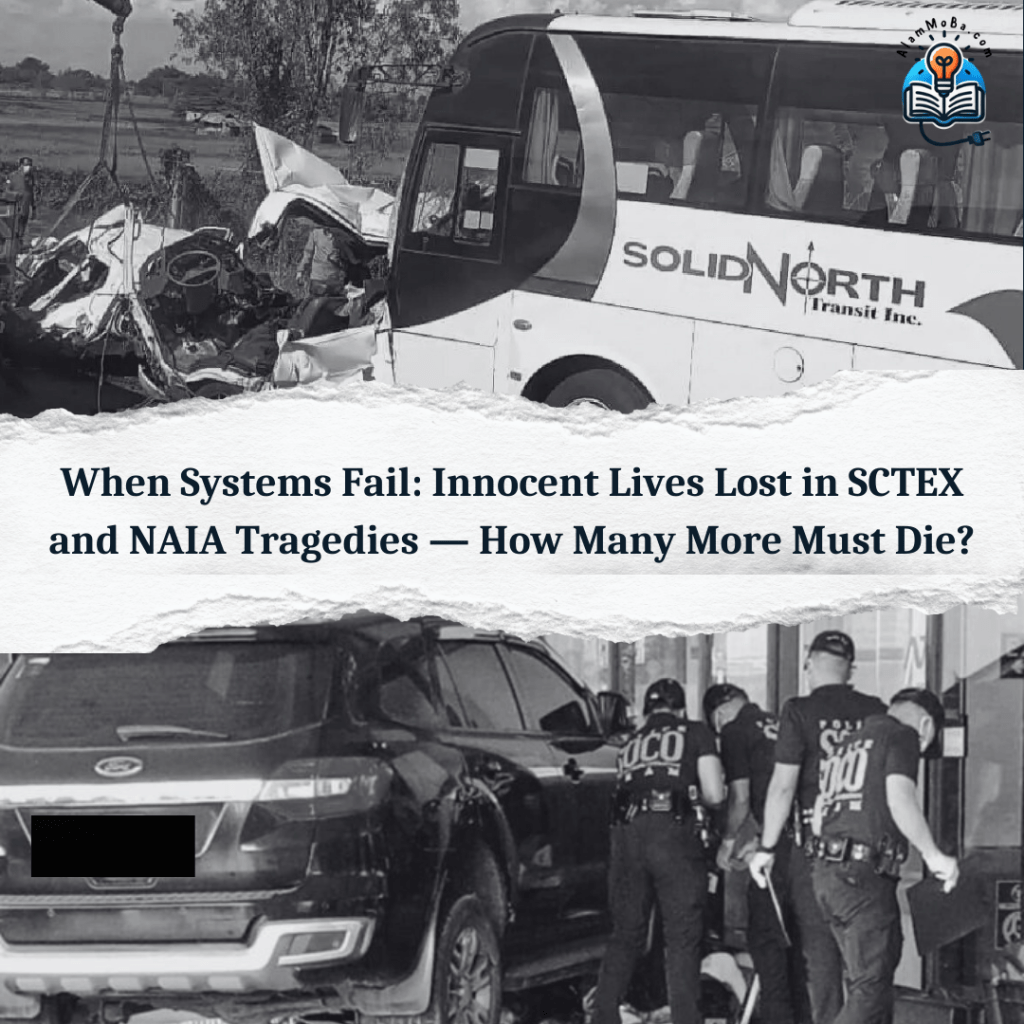
A Massacre on the Highway: The SCTEX Tragedy
On May 1, 2025, a speeding Solid North Transit bus crashed at SCTEX, located in Tarlac City, and hit multiple vehicles while killing ten, four of them children. Thirty-seven others were wounded, some of them gravely injured. Footage from dashcams and descriptions from those who witnessed the crash revealed a scene of metal crumpling, bodies being thrown, and lives cut short in an instant.
Some of the dead were a couple of engineers and a Philippine Coast Guard officer. One of the children who survived is only 2—now orphaned.
These were parents and professionals, kids with hopes and dreams, and loved ones in the wrong place at the wrong time.
How do we talk to a child about this? That their parents are gone because someone failed to slow down? How do we tell these children’s parents that their child is gone?
The last goodbye at NAIA Terminal 1
Three days later, on May 4, 2025, tragedy struck the country’s main airport. A black SUV, allegedly startled by another vehicle, suddenly sped through the NAIA Terminal 1 drop-off point. Within seconds, it had plowed into the crowd.
A 5-year-old girl who had just said goodbye to her father—an overseas worker returning once more to support his family—was killed on the spot. And the 28-year-old man next to her was also killed. Four other people, including airport staff and passengers, were wounded.
Can you imagine that father’s sorrow? All he could scream was, “Anak ko ‘yan!” (“That’s my child!”) Going back to where you had just left your family to see your child already lying lifeless on the floor? This isn’t just a tragedy—it is trauma that no family should ever be forced to experience.
DOTr Responds—Too Little, Too Late?
In response to public outcry, the Department of Transportation (DOTr) implemented wide-ranging changes:
– Compulsory drug test every 90 days for public utility vehicle (PUV) drivers.
– Reduced driving hours from 6 to 4 hours, with mandatory reliefs on long trips.
– In addition, operators or drivers who violate safety rules should be subject to immediate disciplinary actions.
These changes are overdue—tragically overdue. These mandates should have existed years ago, not after people died.
Why are we patching the holes only after the ship has sunk?
A Culture of Recklessness
A viral video days prior to these accidents showed a young moto vlogger named Yanna confidently filming herself during a road altercation. What shocked viewers wasn’t just the argument—it was her proud admission that her motorcycle had no side mirror, followed by the troubling remark: “Sila dapat ang mag-adjust.” (“They should be the ones to adjust.”)
It wasn’t just frustrating—it was heartbreaking. At a time when the country grapples with the consequences of road irresponsibility, someone proudly dismissed a basic safety rule. And the worst part? She’s not alone. This isn’t just one person’s mistake—it’s a reflection of a bigger issue: a growing attitude of carelessness on our roads, where common sense and concern for others seem optional.
The LTO has since issued a summons, but action was taken only after the damage was already done.
The True Cost of Neglect
These tragedies were not by chance. They stem from chronic neglect—from corruption, poor regulation, and an environment that tolerates incompetence. The blood of the lost stains more than just shards of glass and asphalt—it stains a broken system.
We Demand More
This is not a time to move on. It’s time to demand:
– More active law enforcement in traffic matters
– Clear responsibility for public transport operators and their drivers
– Mandatory retraining of PUV drivers
– Public awareness campaigns that don’t just teach—but enforce
We cannot say that the SCTEX and NAIA 1 tragedies are isolated cases. They must become the turning point where we, as a nation, say: “Enough.”
The dead are not just headlines or hashtags. Let them be the cause of our streets getting safer. May their names resound—not in grief—but in lasting change.



 pixelmeow
Leave a comment